

 Skip to content

Kinesio taping (or K-taping) is a veterinary care technique using elastic adhesive tapes applied to the animal’s skin. Their action largely relies on stimulating cutaneous sensory receptors, which constantly inform the nervous system about the body’s position and tension. This action is particularly valuable in horses, whose skin is richly innervated and vascularized, and strongly adherent to the underlying tissue, which favors the transmission of sensory information and responsiveness to taping.
Mainly used in horses, this technique is offered as a complement to osteopathy sessions, never on its own: it helps extend the benefits of the session over time, for a longer-lasting effect.
Kinesio taping is applied as a complement to an osteopathy consultation, particularly in the following situations:
Preparing for the appointment improves treatment effectiveness and ensures a positive experience for your animal. It also allows the veterinarian to work more efficiently and provide care tailored to your animal’s specific needs.
Preparation and application
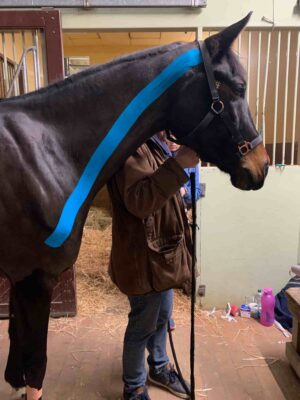
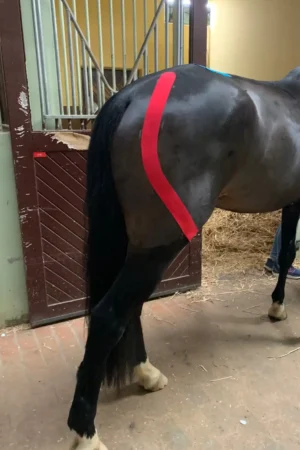
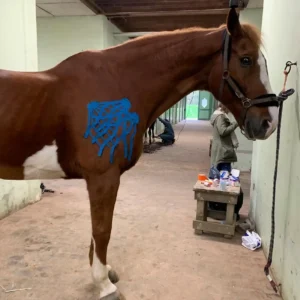
The skin is cleaned and dried to ensure proper adhesion. The tape is then cut and applied with tension adapted to the desired effect, following the anatomical path of the muscle, tendon, or ligament concerned. The tape can stay in place for several days (generally 3 to 5 days), as long as it adheres properly and the animal tolerates it well.
How long it lasts and lifting
How well the tape holds depends on several factors: coat type, the animal’s activity level, and exposure to water or mud. It is normal for the edges to start lifting after a few days, especially in areas of high mobility or friction.
If this happens, do not try to stick it back down or force it to stay in place: simply trim off the parts that have come loose to prevent the rest of the tape from lifting as well. If the tape comes off completely before the expected time, this is not a problem: it has generally already had its effect.
Before your appointment, it’s natural to have a few questions. Let’s go over the most common ones together!
No, the application is painless. The tape is light, flexible, and doesn’t restrict the animal’s movements.
Yes, the animal can carry on with normal activity. Just avoid prolonged swimming and check that the tape stays properly in place.
No. Kinesio taping doesn’t immobilize or stabilize a structure the way a rigid or semi-rigid support does. It’s a complementary tool, not a substitute.
If you have any further questions about kinesio taping for your animal, or would like more information before booking an appointment, please don’t hesitate to contact me — I’ll do my best to get back to you as soon as possible.